

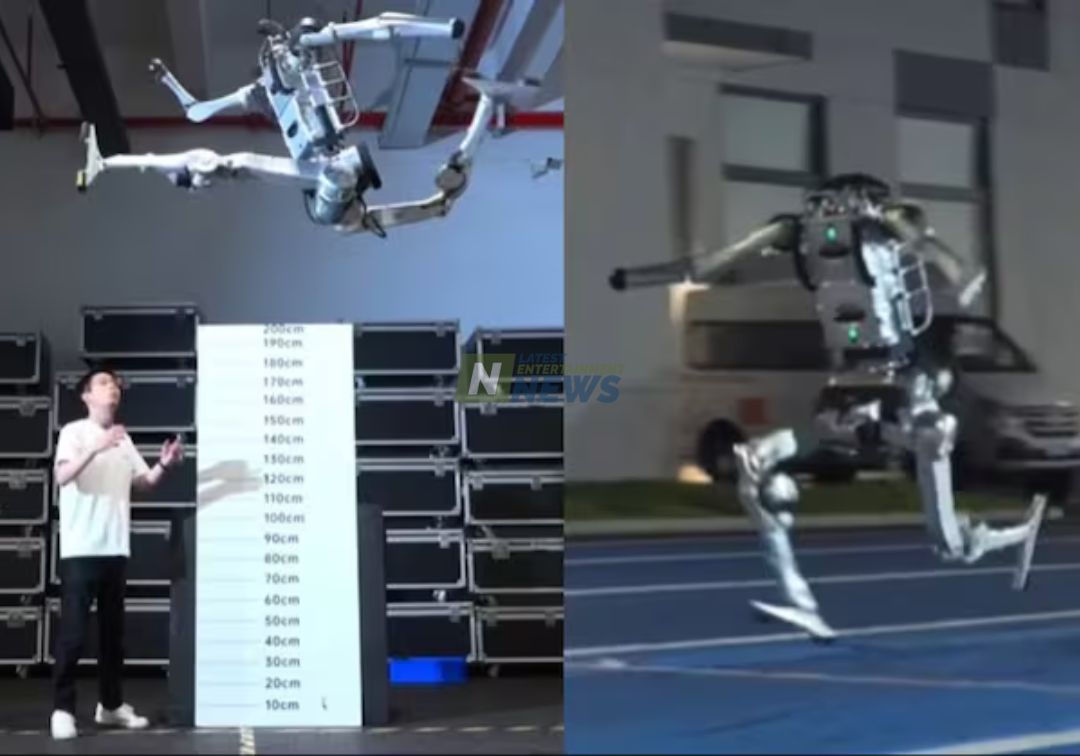
Chinese robotics firm Unitree has unveiled a new humanoid robot nicknamed “Superman,” claiming it has clocked speeds and jump heights that surpass the best human athletes on record, including sprint legend Usain Bolt.
Superman Robot’s Speed Claims Challenge Human Limits
Chinese humanoid robot named “Superman”, made by Unitree Robotics, surpassed Usain Bolt’s world record (12.42 meters/second) by running at 12.66 m/s (roughly 28.3 miles/h) pic.twitter.com/xobXzUPDI5
— Massimo (@Rainmaker1973) August 18, 2026
Unitree says its new humanoid machine reached a top speed of 12.66 metres per second, or roughly 45.6 km/h. That figure edges past the estimated peak speed Usain Bolt hit during his 100-metre world-record run at the 2009 World Championships, when he was believed to have touched around 12.42 m/s (44.7 km/h). Bolt completed that historic 100-metre dash in 9.58 seconds, translating to an average speed of about 10.44 m/s across the full distance, though his peak burst was estimated closer to 12.42 m/s.
Despite the eye-catching numbers, Unitree has not demonstrated the Superman robot completing a full, verified 100-metre sprint faster than Bolt’s official record. The comparison so far rests on top-speed bursts rather than a race over a fixed distance, and social media clips reportedly show the machine struggling to stop cleanly after hitting its highest gear.
Unitree New Robot Preview: “Superman” Breaking the Limits of Humanity🥳
— Unitree (@UnitreeRobotics) August 17, 2026
Standing high jump 2 m, top speed 12.66 m/s (0.85 m leg length)
Surpassing the standing high jump and running speed records of all humans around the world
This new machine has only been in development for a… pic.twitter.com/12i80ITU6p
Beyond raw speed, Unitree says the robot also managed a standing jump of around 2 metres, a mark that would exceed the widely recognised standing high jump record. The current Guinness World Record for a standing high jump belongs to Sweden’s Rune Almén, who cleared 1.90 metres in 1980 — meaning Superman’s claimed leap tops that mark by roughly 10 centimetres, according to reports. Notably, the robot achieves this despite legs measuring just 0.85 metres, considerably shorter than an average adult’s.
Development Timeline and Unitree’s Growing Robotics Push
What has drawn as much attention as the performance claims is the speed of development. Unitree has said the humanoid was built in a little over three months and still has considerable room for improvement. The unveiling arrives at a significant moment for the company. Unitree is preparing to go public on Shanghai’s tech-focused STAR Market at a valuation of around $9 billion, with its IPO reportedly oversubscribed by retail investors more than 8,000 times over — a record for the exchange. The company has said it had cumulatively produced and delivered close to 18,000 bipedal humanoid robots across its various models as of July.
Unitree counts major Chinese technology firms Tencent and Alibaba among its backers, alongside AI company DeepSeek, and its founder Wang Xingxing has previously been recognised at a national technology summit hosted by President Xi Jinping. The Superman unveiling reflects Beijing’s broader push to position China as a leader in humanoid robotics, an industry that has seen a wave of Chinese state-backed investment in recent years.
While Unitree’s claims have generated buzz online, robotics observers note that controlled demonstrations differ meaningfully from standardised athletic competition, and independent verification of the figures has yet to emerge. For now, Superman stands as a striking symbol of how quickly humanoid robots are closing the gap with — and in some metrics, surpassing — elite human performance.